
Key Takeaways
- Space vs Keys: 25-key controllers save up to 20 inches of desk space compared to 49-key models, but limit two-handed playing capabilities
- Mini vs Full-Size Keys: Mini keys reduce accuracy for complex chord progressions and can feel cramped for larger hands
- Feature Compromises: Compact controllers sacrifice I/O ports, display quality, and control knobs to achieve smaller footprints
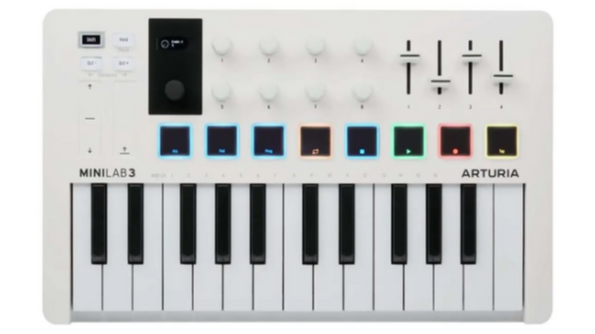
- Optimal Balance: The Arturia MiniLab 3 demonstrates how premium compact controllers can maximize functionality within space constraints
- Genre Matters: Beat-makers thrive with 25 keys, while pianists need 49+ keys for proper two-handed compositions
Choosing the right mini MIDI controller means balancing precious desk real estate against musical functionality. Home studio producers face a constant struggle: cramped workspaces demand compact gear, yet musical creativity shouldn’t suffer from size limitations. Understanding these trade-offs helps identify which compromises align with specific production needs.
Why 25-Key Controllers Excel at Portable Production
Ultra-compact 25-key controllers revolutionize mobile music production by fitting into laptop bags alongside computers and cables. These miniature powerhouses weigh between 0.5-1.7 pounds, making them ideal companions for bedroom producers, traveling musicians, and coffee shop composers. The portability factor becomes vital when studio space doubles as living space or when inspiration strikes during commutes.
Many 25-key models feature mini keys, which typically measure smaller than full-sized keys. This reduction allows manufacturers to pack essential functionality into footprints smaller than most laptops. The space savings prove dramatic – where a standard keyboard might occupy an entire desk edge, compact controllers leave room for monitors, audio interfaces, and reference speakers.
Professional producers increasingly rely on compact controllers for sketch pads and idea capture rather than full compositions. The limitation of two octaves encourages focus on melodic phrases, basslines, and drum programming rather than complex harmonic arrangements. One example of this is the Arturia MiniLab 3, which exemplifies how modern compact controllers maximize control density without sacrificing build quality.
Real Size Differences: 25-Key vs 49-Key Measurements
1. Ultra-Compact 25-Key Dimensions and Weight (Akai MPK Mini MK3: 12.5″ x 7.13″ x 1.75″, 1.65 lbs)
The Akai MPK Mini MK3 represents the gold standard for ultra-portable MIDI controllers, measuring just 12.5 inches wide – roughly the length of a standard ruler. At 1.65 pounds, this controller weighs less than most textbooks while packing 25 mini keys, 8 backlit pads, and 8 assignable knobs. The shallow 1.75-inch height allows stacking beneath laptops or sliding into tight desk drawers when not in use.
Similar compact models like the Korg nanoKEY2 push miniaturization even further, measuring only 12.8 x 3.27 x 0.65 inches and weighing 0.54 pounds. These ultra-thin profiles prioritize maximum portability over playability, making them perfect for musicians who prioritize mobility above all else. The trade-off involves sacrificing knobs, pads, and substantial key travel for unprecedented portability.
2. Standard 49-Key Controller Footprint (M-Audio Keystation 49 MK3: 32.3″ x 7.4″ x 2.7″, 4.7 lbs)
The M-Audio Keystation 49 MK3 illustrates the substantial size jump to mid-range controllers, stretching 32.3 inches wide – nearly three times the width of 25-key alternatives. This extended footprint demands dedicated desk space equivalent to a large monitor or multiple laptops placed side by side. The 4.7-pound weight, while still portable, requires deliberate packing decisions for mobile setups.
These dimensions accommodate full-sized keys with improved spacing and natural finger positioning. The extra width provides room for additional octaves without cramping, allowing comfortable two-handed playing across bass and treble ranges simultaneously. However, the size increase means most 49-key controllers become permanent desk fixtures rather than grab-and-go accessories.
3. Desk Space Impact Analysis
The mathematical reality reveals striking differences in workspace consumption. A 25-key controller occupies roughly 89 square inches of desk surface, while 49-key models consume approximately 239 square inches – nearly three times the footprint. For bedroom producers working on small desks, this difference determines whether space remains for audio interfaces, reference monitors, or mouse pads.
Vertical clearance also impacts setup flexibility. Compact controllers slip beneath monitor stands or laptop screens, maintaining clean sight lines to digital audio workstations. Larger controllers often force awkward angles or require dedicated keyboard trays, adding complexity to already cramped home studio configurations.
Mini Keys vs Full-Size Keys: Playability Trade-offs
When Mini Keys Limit Complex Chord Progressions and Playing Speed
Mini keys present significant challenges for musicians transitioning from acoustic pianos or full-sized digital keyboards. The reduced key width forces finger repositioning and increases accidental note triggers during rapid passages or complex chord voicings. Jazz pianists and classical musicians find mini keys particularly limiting when attempting extended chords or intricate fingering patterns that require precise key spacing.
Professional keyboardists report decreased accuracy rates with mini keys, especially during extended playing sessions. The narrow surface area provides less tactile feedback, making blind positioning – vital for live performance – considerably more difficult. Additionally, the reduced key travel distance affects expression and dynamics, limiting the nuanced touch control that experienced players rely upon for musical phrasing.
Full-Size Key Options in Compact Controllers (Native Instruments Komplete Kontrol A25)
Several manufacturers address playability concerns by incorporating full-sized keys into relatively compact designs. The Native Instruments Komplete Kontrol A25 measures 15.7 x 9.8 x 2.8 inches while maintaining standard key dimensions, representing an intelligent compromise between portability and playability. This approach sacrifices extreme portability for improved musical expression and accuracy.
Full-sized keys in compact controllers enable proper finger technique development and facilitate seamless transitions between practice instruments and performance keyboards. Musicians with larger hands particularly benefit from standard key spacing, reducing fatigue and improving playing comfort during extended sessions. The trade-off involves accepting slightly larger dimensions while gaining significant playability advantages.
Feature Compromises in Compact Designs
1. Reduced I/O and Control Options (Fewer Knobs, Missing Sustain Pedal Input)
Miniaturization forces manufacturers to eliminate connection ports and reduce control surfaces that larger keyboards take for granted. Some ultra-compact controllers omit sustain pedal inputs, forcing musicians to rely on software sustain or MIDI CC messages for legato playing. This limitation proves particularly problematic for piano-focused compositions where sustain pedal technique forms a vital element of musical expression.
Control knob reduction from 16+ on larger controllers to 4-8 on compact models limits real-time parameter manipulation. Sound designers and electronic music producers find themselves menu-diving through software interfaces rather than having immediate tactile control over filters, envelopes, and effects. The workflow impact extends beyond convenience, potentially disrupting creative flow during inspired moments.
2. Display and Interface Limitations (Limited OLED vs No Display Options)
Screen real estate becomes premium territory on compact controllers, with most models either omitting displays entirely or providing minimal LED feedback. Advanced controllers like the Novation Launchkey series include small OLED screens, but compact variants often rely solely on button LEDs and computer screens for parameter feedback. This limitation forces musicians to maintain visual contact with computer monitors rather than focusing on the physical controller.
Parameter editing becomes more complex without dedicated displays, requiring memorization of button combinations or software interface navigation. Live performers particularly struggle with this limitation, as stage lighting conditions often make computer screens difficult to read while dedicated controller displays remain clearly visible.
3. What You Keep vs What You Lose
The core functionality preservation focuses on note input, basic MIDI control, and USB connectivity – the fundamental elements for music production. Quality compact controllers maintain velocity-sensitive keys, pitch bend wheels or joysticks, and assignable knobs for vital parameters like filter cutoff and resonance. These fundamentals support most home studio workflows without major creative limitations.
Lost features typically include advanced connectivity options like MIDI DIN ports, CV outputs, multiple USB ports, and expression pedal inputs. Audio interfaces, arpeggiators, and internal sound generation capabilities also face elimination in pursuit of size reduction. Musicians must evaluate whether these sacrificed features impact their specific production methods and performance requirements.
Musical Range Limitations: When Two Octaves Aren’t Enough
Single-Hand Melodies vs Two-Handed Playing Requirements (49+ Keys Recommended)
Two-octave limitations confine musicians to single-handed playing or frequent octave switching during complex arrangements. Simple melodies, basslines, and drum programming work perfectly within 25-key constraints, but classical pieces, jazz standards, and complex pop arrangements demand extended ranges. Pianists attempting to play authentic chord progressions with bass notes find constant octave adjustment disruptive to musical flow and creative expression.
The mathematical reality restricts harmonic possibilities – full jazz chords often span more than two octaves, forcing uncomfortable voice leading compromises or eliminating chord tones. Similarly, classical repertoire assumes extended keyboard ranges, making authentic performance impossible on compact controllers without significant musical adaptation.
Genre-Specific Key Count Needs (Pianists vs Beat-Makers)
Electronic music producers and hip-hop beat-makers thrive within 25-key limitations, as their workflows emphasize rhythm programming, short melodic phrases, and layered textures rather than extended harmonic structures. Trap, house, and techno production rarely requires simultaneous bass and treble playing, making compact controllers perfectly adequate for these genres.
Conversely, singer-songwriters, jazz musicians, and classical composers require extended ranges for authentic performance and composition. These genres rely heavily on two-handed techniques, complex chord voicings, and melodic lines that span multiple octaves. The limitation becomes particularly apparent when accompanying vocalists, where piano parts typically cover bass, harmony, and melody simultaneously across wide ranges.
Top Compact Models That Balance Size and Function
1. Best 25-Key: Akai MPK Mini MK3
The Akai MPK Mini MK3 represents the pinnacle of 25-key controller design, combining production tools in an ultra-portable package. Its 8 velocity-sensitive RGB pads excel at drum programming and sample triggering, while 8 assignable knobs provide parameter control for filters, effects, and virtual instruments. The 4-way joystick offers dynamic pitch bend and modulation control, replacing traditional wheels with space-saving innovation.
Build quality exceeds expectations for the price point, with solid construction that survives regular transport and studio use. The integrated arpeggiator adds creative possibilities for melodic sequence generation, while software integration supports major DAW platforms. At $119 street price, this controller delivers exceptional value for mobile producers and bedroom studio setups.
2. Budget-Friendly 49-Key: M-Audio Keystation 49 MK3 (Ideal for Beginners)
The M-Audio Keystation 49 MK3 provides full-sized key experience without premium pricing, making it ideal for beginners transitioning from acoustic pianos or musicians requiring extended range on limited budgets. The streamlined design focuses on functionality – quality keys with velocity sensitivity and basic MIDI connectivity – without overwhelming new users with complex features.
Its plug-and-play USB design eliminates driver installation complexity, while the included software bundle provides immediate access to virtual instruments and recording capabilities. The full-sized keys facilitate proper technique development, preventing bad habits that mini keys might encourage. For around $100, this controller offers excellent introduction to MIDI production with room to grow as skills develop.
3. Ultra-Portable Option: Korg nanoKEY2
The Korg nanoKEY2 pushes miniaturization to extremes, measuring just 0.65 inches thick and weighing 0.54 pounds. This ultra-slim profile slips into laptop bags or even large pockets, making it perfect for musicians who prioritize absolute portability over features. The touch-sensitive keys respond to velocity, maintaining expression capabilities despite the minimal footprint.
USB bus power eliminates external power requirements, enabling use with laptops and computers in completely mobile setups. While lacking knobs, pads, or displays, the nanoKEY2 excels as a pure note-input device for traveling composers and mobile sketch pad applications.
Choose Based on Your Studio Space and Playing Style
The optimal mini MIDI controller choice depends on balancing workspace constraints against musical requirements and playing techniques. Bedroom producers with minimal desk space benefit most from ultra-compact 25-key controllers that preserve functionality while maximizing available workspace for monitors, interfaces, and other gear.
Musicians with classical training or complex harmonic needs should prioritize larger controllers with full-sized keys and extended ranges, even if desktop real estate becomes constrained. The playability improvements and expanded musical possibilities justify the space investment for serious keyboard work and composition.
Budget-conscious beginners should consider 49-key options like the M-Audio Keystation series, which provide room to grow musically without immediately outgrowing the controller’s capabilities. These models offer better long-term value despite larger footprints, supporting skill development and expanding musical ambitions.
Genre preferences strongly influence optimal key counts – electronic music producers rarely need more than 25 keys, while jazz pianists and classical composers benefit significantly from 49+ key models. Honest assessment of musical goals and production styles guides better purchasing decisions than pure specification comparisons.
Ultimately, the best mini MIDI controller maximizes creative possibilities within available space constraints, supporting musical expression rather than limiting it.
Sam Ash
278 Duffy Ave
Unit B
Hicksville
New York
11801
United States
