


Tapati Rinchumrus // Shutterstock
How better product data is reshaping digital commerce
E-commerce businesses that fail to centralize product data face a compounding crisis: Fragmented systems erode brand trust, slow fulfillment, and leak revenue to competitors with unified data foundations. Whether a consumer scrutinizes a label during economic uncertainty or a business-to-business (B2B) buyer commits significant capital in a digital transaction, data quality determines trust.
Poor data, however, kills conversions, tanks operational efficiency, and fractures the customer experience across channels. Yet many organizations still treat data as a back-office information technology problem rather than the primary engine of growth it has become.
DigitBridge, an omnichannel operations systems provider, explored how better product data is reshaping digital commerce.
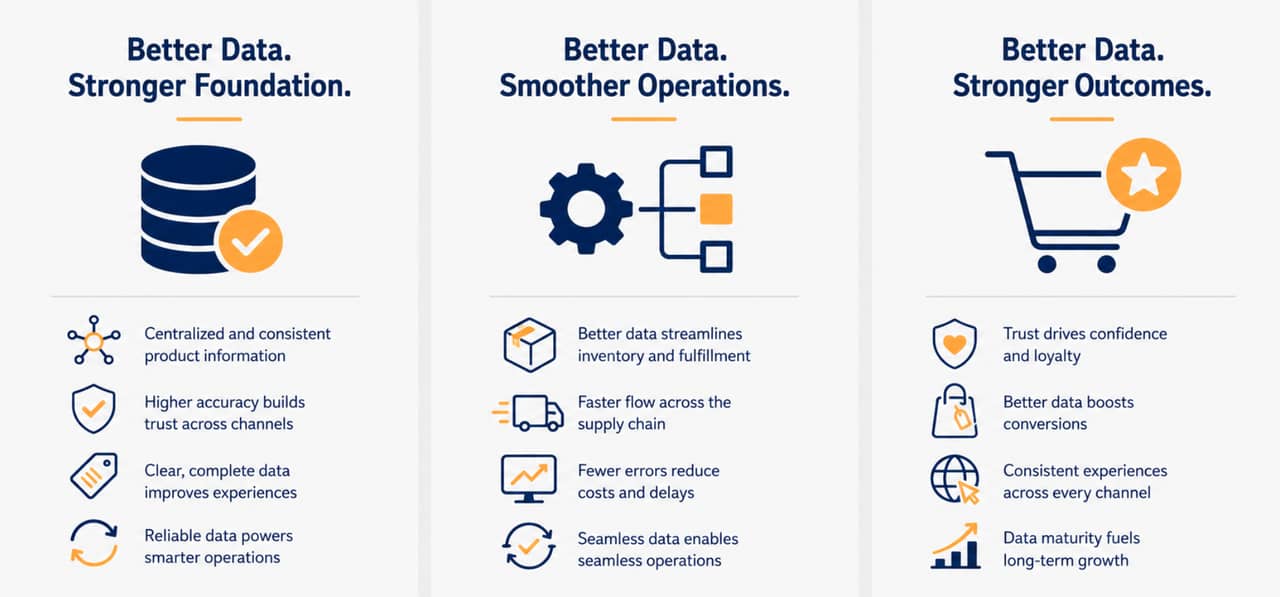
DigitBridge
How Data Quality Drives Customer Trust and Revenue
An overview of insights into the importance of data quality in digital commerce comes courtesy of GS1, which put together a recent white paper on the value of trust throughout the supply chain. First, it highlights that decision-makers in the industry are well aware of the upsides, with 63% of respondents in a 2025 survey stating that streamlined data sharing enabled tangible improvements in core processes, including product inventory management and goods distribution.
The paper also highlights the case study of retail giant Target, which went from having four team members dedicated to data quality management in 2015 to employing more than 20 professionals in this sphere a decade later. In this case, centralization, combined with human accountability, was emphasized as important for improving and maintaining long-term product data quality.
Another GS1 report focuses on the significance of trust, particularly in targeting consumers with food products at a time of inflation that leaves 80% exposed to higher prices. As prices grow, so too does the amount of attention shoppers pay to product details, with 71% saying they look into data displayed on food labels more closely if they’re expected to hand over more money at checkout.
Trust is harder to earn and maintain if companies are not transparent about their products, and this gets tougher the higher up the price range a product sits. Thus, better product data can allay buyer fears and win sales, while also providing behind-the-scenes benefits for supply and distribution efficiency.
Unifying commerce through a shared data foundation is fundamental to organizations finding their footing when economic confidence is suboptimal. As demonstrated in the aforementioned report, brands can expect buyers to hold them to higher standards when prices are higher, and delivering on these expectations requires high-quality, easily shared data.
Why B2B Buyers Demand the Same Data Consistency as Consumers
Business-to-consumer (B2C) benefits from better product data are obvious. B2B depends on it just as much—though the stakes are higher.
Data collated by McKinsey demonstrates this relationship, focusing on how omnichannel experiences are a defining factor of the buying journey today, with confidence in digital transactions growing when businesses buy from businesses. An average of 10 channels are used by typical B2B customers when progressing along the sales funnel, and more than half want to see an improvement in the seamlessness of the buyer experience as they move between them.
In terms of the channel that dominates revenue generation, e-commerce holds the largest share at 34%. Meanwhile, only 17% of sales occur in person, and higher-value sales are also more frequently conducted remotely. 73% of B2B buyers said they would happily spend more than $50,000 via digital commerce channels, while 39% would spend over $500,000, and 20% would exceed $1 million.
This state could only have been reached with better product data. If a consumer needs to trust a brand when they’re spending $10 online, that must be magnified many times over when a B2B buyer is putting $50,000 or more on the line.
Data Maturity as the Competitive Dividing Line
Ultimately, high-quality product data has moved from a back-office IT requirement to a primary engine of commercial growth. Whether a business is catering to a budget-conscious consumer scanning a label or an enterprise buyer navigating a complex $500,000 procurement workflow, data fidelity serves as the proxy for brand trust.
Now that digital channels are both the front door and the primary revenue generator for modern enterprise, organizations that treat their data as a strategic asset will consistently outpace competitors in operational agility, customer conversion, and long-term brand loyalty.
As commerce channels continue to multiply and customer expectations rise, the divide between data-mature businesses and those relying on fragmented legacy systems will only widen.
Investing in standardized, centralized, and accountable product data management is a means of laying the infrastructure required to scale.
This story was produced by DigitBridge and reviewed and distributed by Stacker.

